Sometimes, Audacity Is a Dance
For a long time, I had the wrong mental picture of audacity.
Not the definition. The picture.
The word came with clenched teeth.
Rage. Aggression. Defiance. Someone forcing his way through the world as if every closed door were a personal insult.
And yes, audacity can look like that.
But I don’t think that is audacity itself. I think that is only one emotional colour it can wear.
The word itself carries this tension. It can mean “intrepid boldness.” It can also mean “arrogant disregard of normal restraints.” So I had not completely imagined the aggression. Audacity carries both the pioneer and the asshole inside it.
Still, I had reduced an entire principle of movement to one of its costumes.
Then I started thinking about another word we keep using.
Delusion.
“You have to be delusional.”
“You need delusional self-belief.”
We say it about founders, scientists, artists, athletes. Anyone attempting something that looks unreasonable from where the rest of us are standing.
If it fails, delusional.
If it works, visionary.
That feels a little too convenient.
I was thinking about Elon Musk. But not really about Elon Musk.
I was thinking about anybody setting out to do something for which the evidence has not arrived yet. A scientist working on a problem nobody has solved. An artist hearing something that does not exist yet. A person trying to build a life nobody around them can recognise.
Are they delusional?
I don’t think so.
I think we have been using the wrong word.
Delusion is the wrong word
I mean the way we casually use the word in ambition culture. In its clinical sense, delusion is not a motivational accessory.
One useful clinical definition describes a delusion as a fixed false belief that remains despite evidence to the contrary.
The important word is not false.
It is fixed.
That changes the whole distinction.
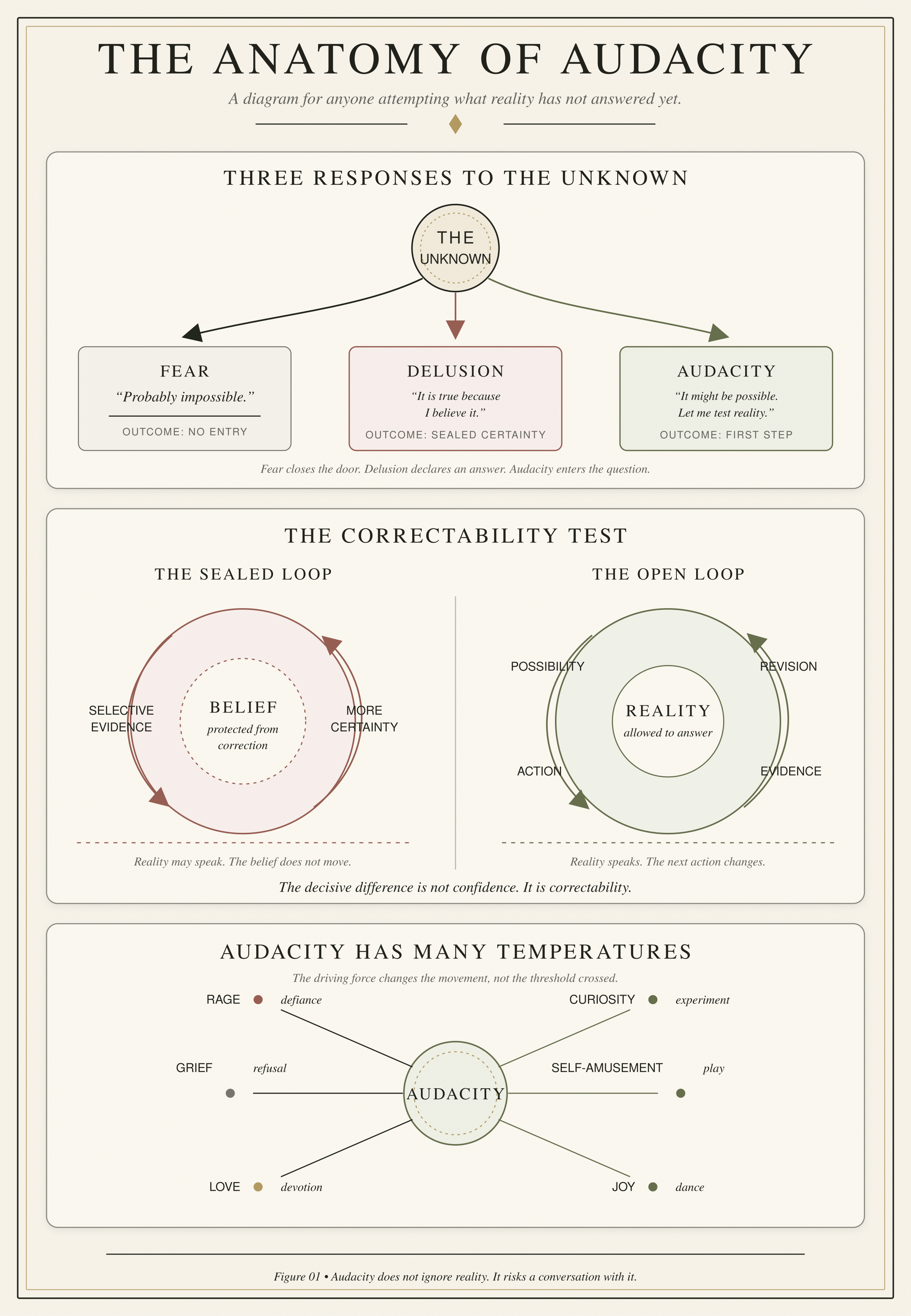
A delusional mind says:
It is true because I believe it.
Audacity says:
It might be possible. Let me test reality.
One is certainty pretending to be vision.
The other is possibility becoming action.
Delusion ends the conversation with reality.
Audacity begins one.
The unknown is not the impossible
Before something exists, there is often very little evidence that it can.
That does not make it impossible.
It makes it unanswered.
Reality contains at least three territories:
What is known to be possible.
What is known to be impossible.
What has not been answered yet.
Most worthwhile ambition begins in the third.
But the unknown is uncomfortable. We want to collapse it quickly.
Fear collapses it into impossibility.
Delusion collapses it into certainty.
Audacity leaves it open long enough to enter.
Fear says:
Probably impossible. Don’t move.
Delusion says:
Definitely true. Don’t question me.
Audacity says:
Maybe. Let’s find out.
That maybe is not weakness. It is intellectual honesty.
And let’s find out is the courage.
The reality test
In 1901, the Wright brothers had already built and flown gliders. They were not sitting in a room manifesting aviation.
And their machines were not behaving as expected.
One of their gliders produced only about one-third of the lift their calculations had predicted.
At that point, they had three options.
They could decide flight was impossible.
They could insist their belief was right and treat every failure as irrelevant.
Or they could ask reality a better question.
They built a wind tunnel. Tested wing shapes. Measured lift and drag. Corrected the data they had inherited. Changed the machine.
Then they tried again.
That is audacity.
Not blind belief.
A belief bold enough to enter the experiment, and a mind humble enough to be changed by it.
This is what scientists do all the time. The original question may be enormous. The next action is usually embarrassingly small.
A measurement.
A model.
A failed test.
A correction.
Another test.
Curiosity asks:
What if?
Audacity says:
Let’s find out.
Audacity does not have one emotional temperature
This was the part I had missed.
I had been picturing the behaviour through only one possible driving force.
If audacity is driven by rage, it may look like defiance.
If it is driven by grief, it may look like refusal.
If it is driven by love, it may look like devotion.
If it is driven by responsibility, it may look almost quiet.
If it is driven by curiosity, it looks like an experiment.
If it is driven by self-amusement, it looks like play.
If it is driven by joy, it can look like a dance.
Same threshold crossed.
Completely different movement.
Audacity is not rage. Rage can become audacity.
Audacity is not aggression. Aggression can carry it.
Curiosity can become audacity.
Self-amusement can become audacity.
Love can become audacity.
The source changes the rhythm.
Maybe one person breaks the door down.
Maybe another studies the lock.
Maybe someone else builds a new door because the old one is boring.
All three may be audacious.
One just makes a better film.
You do not need certainty
Maybe our obsession with “delusional self-belief” comes from thinking action requires certainty.
It doesn’t.
I do not need to know that I will succeed.
I need enough belief to begin, enough humility to observe, and enough courage to continue changing.
That is a much stronger position than pretending I already know the ending.
Delusion protects the belief.
Audacity risks it.
Every real experiment contains the possibility that reality will say no. If no answer could change your mind, you are not testing anything. You are only performing certainty.
Audacity does not demand that reality agree with you.
It demands that you meet reality yourself.
A conversation, not a conquest
We often think the opposite of audacity is fear.
Sometimes it is.
But I think the deeper opposite is obedience to the current shape of reality.
This exists, therefore only this can exist.
This has never been done, therefore it cannot be done.
Nobody around me can see it, therefore there is nothing to see.
Audacity does not claim that all limits are imaginary.
Gravity is real.
Time is real.
Consequences are real.
Some doors are closed because there is a wall behind them.
Audacity simply refuses to confuse the present boundary of proof with the final boundary of possibility.
That is the whole thing.
Not:
I am right.
Not:
I am destined.
Not:
The universe has already said yes.
Just:
There may be something here.
I am willing to find out.
And maybe that is why audacity can feel like war from one person, prayer from another, and play from someone else.
The audacious person is not always charging at reality.
Sometimes he is listening to it.
Sometimes he is building with it.
Sometimes, he is dancing with it.