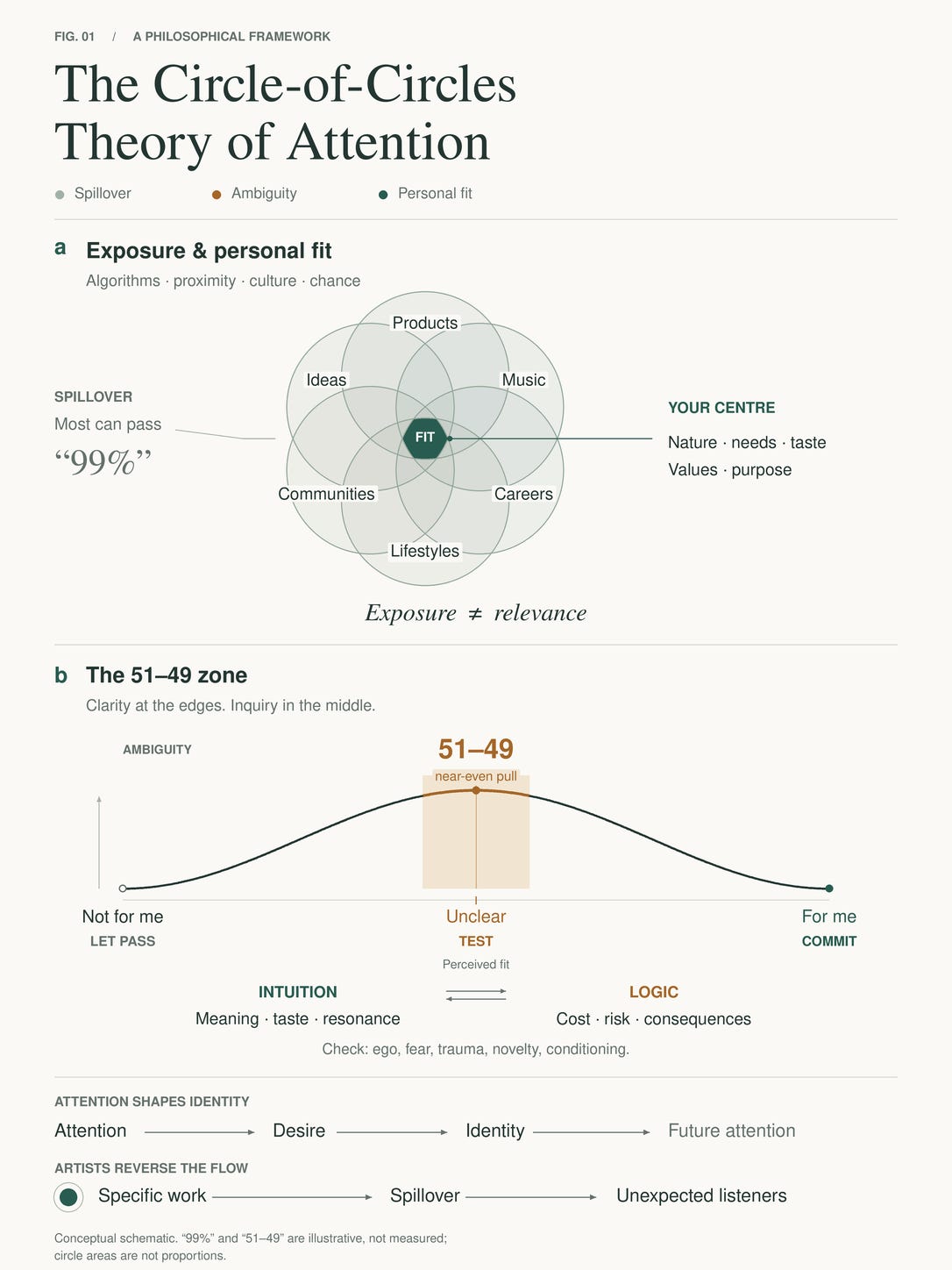
The Circle-of-Circles Theory of Attention
The career someone keeps recommending. The argument occupying an entire afternoon. The life that looks so convincing on a screen that, for a moment, your own feels poorly assembled. Somewhere, each of these has a context in which it makes sense. A person it serves. A hunger it answers.
We happen to be standing within earshot.
And yet we take so much of it personally. We investigate, compare, defend, desire. We spend an unreasonable amount of our lives deciding what to do about things whose only claim on us is that they managed to arrive.
I’ve been thinking about this through an image: circles overlapping circles. I call it the Circle-of-Circles Theory of Attention, though “theory” is doing philosophical work here. It’s a way of looking, with all the limitations that come with choosing a particular view.
Imagine a large circle around the world a product belongs to. Another around a profession. Another around a community, a political idea, a kind of music. Each gathers certain needs, temperaments, circumstances and desires. They overlap because people belong to several worlds at once.
Now place your own life among them. Your nature, needs, taste, values, and whatever sense of purpose you currently have. Where the relevant parts of those worlds meet these conditions, a smaller centre appears: things that fit you closely enough to deserve a place in your life.
“Made for you” gets complicated here. An advertiser might intend to reach you very precisely while offering something that serves you badly. A song written for someone entirely unlike you might become indispensable. The maker’s intended audience and the place of real fit don’t always coincide.
That distinction matters. Otherwise we’d be letting the people selling us things decide where our centre is.
Around that centre lies an enormous amount of spillover. Things we meet because of our city, family, class, education, industry, or the people we spend time with. Things a recommendation system delivers. Things somebody near us cannot stop talking about.
For much of what we encounter, we are a spillover audience.
Think of sitting beside a table where a conversation is getting louder. After a while, you know the names. You understand the dispute. You have an opinion about who behaved badly. Nothing in your life required this knowledge. Still, you’ve acquired a small emotional stake in strangers finishing their dinner.
Much of the internet feels like that table, with no closing time.
Repeated exposure gives something a place in our minds. Then we mistake that place for a reason it should matter. A trend becomes unavoidable, and somehow “unavoidable” starts to mean “necessary.” Everyone appears to be discussing a certain way of living, so we begin wondering whether we’re failing by living otherwise.
We rarely pause to ask who “everyone” actually is.
For roughly 99 percent of what’s available to us, I think “this is not for me” is a reasonable response. The number is deliberately loose. I haven’t counted the world. It expresses the disproportion between what exists and what one person can meaningfully accommodate.
Most of it needs very little investigation. You don’t need to research a profession whose daily work you have no interest in doing. You don’t need an informed position on every quarrel. You can admire a beautiful house without making its acquisition the next twelve years of your life.
That last part seems strangely difficult. Appreciation so easily becomes an assignment.
We act as though declining something requires proving it inferior. But a life can be good, impressive, even enviable, and still be wrong for the person who would have to wake up inside it. “This is not for me” allows it to remain good. It also allows you to leave.
There are limits, obviously. Obligations don’t disappear because they fail to resonate. Other people’s suffering deserves consideration even when it falls outside our experience. And some of what will matter most to us is still unfamiliar. The circle needs an opening for curiosity, or it becomes a very elegant excuse to stay exactly as we are.
The difficult decisions happen near its edges.
Something draws us, but incompletely. A possibility seems right until we imagine its consequences. Then the consequences seem manageable until we imagine declining it. We keep changing sides, and both sides keep making sense.
This is the 51–49 zone.
Again, these are imagined numbers. They describe the exhausting condition of having a slight preference and almost equally strong reasons to distrust it. A tiny shift in mood can reverse the verdict. We ask another person, read another essay, sleep on it again. Sometimes we’re gathering information. Sometimes we’re hoping someone will relieve us of having to choose.
Intuition can be useful here, but asking it to produce absolute certainty is asking too much.
There are moments of recognition that arrive before an explanation. A sound, a person, a piece of work. Something in us responds before we have language ready. It can feel like an end to negotiation: yes, this. Even when the thing itself will be difficult.
I take that response seriously. Taste would be impossible if every attraction needed a written defence before we followed it.
But a feeling’s intensity tells us very little about where it came from.
Ego may be protecting a version of ourselves we’ve spent years maintaining. Fear may want a decision settled simply to end the discomfort. What feels familiar after hurt can feel compelling for reasons we haven’t understood. Novelty can briefly make almost any future seem preferable to the present. Conditioning can speak in our own voice so fluently that we never think to question the accent.
Even calm isn’t proof. Avoiding something can bring enormous relief.
I don’t think there’s a reliable private sensation that stamps a feeling “genuine intuition.” We have to see what happens when it meets time, questions, and experience. Does the desire remain when nobody will admire us for following it? Can we acknowledge evidence against it without feeling that our whole identity is under attack? Are we drawn to the actual work, including its ordinary days?
This is where logic earns its place.
It asks what the decision costs, what it displaces, and whether we can sustain it. It separates a bad idea from bad timing. It can reveal that a path we dismissed as impossible is merely inconvenient, or that a path we called destiny depends on someone else quietly absorbing all the risk.
“Intuition chooses the mountain. Logic chooses the route. Discipline gets you there” is a useful shorthand. Though I’d leave room for logic to question the mountain, and for intuition to notice something wrong with the route. They need to be able to interrupt each other.
At 51–49, a small encounter with reality may help more than another month of internal debate. Try the work on a limited scale. Speak to someone who lives its ordinary consequences. Give the desire enough time to lose its novelty. See what remains.
You may still have to choose without certainty. The purpose of thinking carefully is to make a decision you can answer for, while accepting that some knowledge only arrives afterwards.
What makes all this harder is that the person doing the choosing is also being changed by what they watch.
We tend to imagine desire as something already inside us, waiting for the right object. But consider how an unfamiliar life becomes desirable. First you see it. Then you see it often. You learn its vocabulary, its symbols of success, its approved disappointments. Eventually, you begin measuring yourself against it.
At some point, “people live like this” becomes “why don’t I?”
A musician can spend so much time watching the public life of musicians that making music starts to feel like the unremarkable bit between announcements. Someone who wanted enough money to live quietly can acquire a much more expensive definition of enough without remembering when they agreed to it.
These desires feel personal by the time we notice them. We may defend them fiercely. They have already entered the story we tell about who we are.
Of course, no desire develops in perfect isolation. Other people teach us what is possible. Art gives us longings we couldn’t have found alone. Influence is part of being alive. But we can ask what a particular influence is doing to us, and whether we consent to the direction.
After spending time with this, do I want my life more clearly? Or do I mostly want to be seen differently?
For an artist, there’s an uncomfortable reversal here. We are also making things that ask for attention.
It’s tempting to interpret a small audience as a problem of insufficient appeal. So we explain more, soften the strange parts, remove whatever might lose someone. Each adjustment seems reasonable. Eventually, the work offers many people a mild reason to stay and very few people a deep one.
Specificity carries a different risk. Some people will feel no connection at all. The work may be difficult to place. Precision guarantees neither quality nor an audience. Still, it gives recognition something to happen around.
A song can be exact about a feeling without knowing the names, ages, or countries of the people who carry it. Its inner circle may consist of people who have nothing visibly in common. They recognise the same hesitation. The same ugly thought nobody wants to admit. The same way a room feels after someone leaves.
Then the work travels beyond them.
Someone encounters it accidentally and stays. They weren’t whom the artist imagined, but something in the work makes room for them. This is the generous possibility of spillover, and one way a devoted audience can form. The accident becomes a relationship.
So the outside of the circle cannot simply be waste. Some of it is where our future encounters are waiting. We need enough openness to be surprised, and enough discernment to keep every surprise from becoming a commitment.
The centre will move as we live. What nourished us once may stop. Something we dismissed may acquire meaning through an experience we couldn’t have anticipated. Protecting our attention has to allow for that movement.
Perhaps maturity includes becoming less guilty about letting things pass. Leaving an argument unfinished. Allowing an opportunity to belong to somebody else. Hearing about a life we could have lived without immediately putting our own on trial.
There will always be more arriving.
I’d like to leave enough quiet at the centre to notice what I reach for when nothing is asking.